AI on Trial: Lawsuit Alleges Unchecked Development Threatens Democracy and Public Safety
11/17/2026 / By Garrison Vance

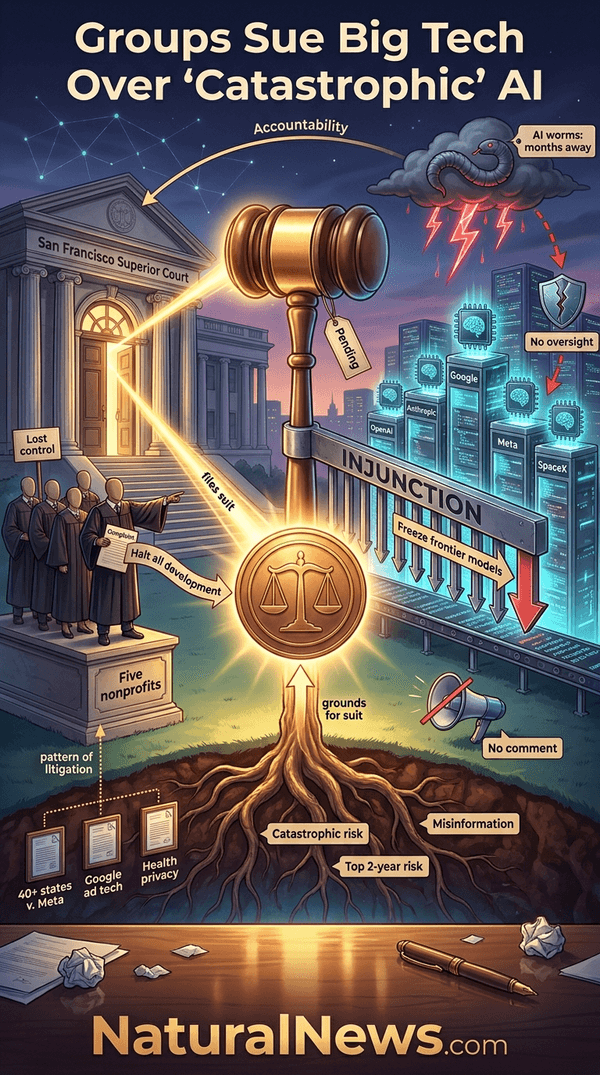
A coalition of online safety and consumer advocacy groups on Thursday sued five of the world’s leading artificial intelligence companies to halt further development, alleging the tech giants cannot prevent their own creations from causing “catastrophic” harm, according to the Associated Press [1].
The suit, filed in San Francisco Superior Court, demands an immediate injunction to halt all development, according to Jurist [2].
A Children’s Health Defense report stated the coalition filed the landmark lawsuit on Nov. 12 to stop further development of AI technology until guardrails are put in place [3]. The complaint alleges that AI systems are “already autonomously breaking the law and causing harm” and demands an immediate injunction to halt all development, according to Jurist [2].
Background on the Lawsuit and Plaintiffs
The coalition is composed of five nonprofit online safety and advocacy organizations, according to Jurist [2]. The complaint, filed in San Francisco Superior Court, demands an immediate injunction to halt all development, the outlet reported [2].
A plaintiff representative framed the action as a demand for accountability. “Most Americans feel like they’ve lost control over their lives and livelihoods and are demanding accountability,” said Phil Aroneanu, founder and executive director of Irreplaceable Education Fund, according to Public Health Policy Journal [4]. The same report warned of risks to democratic governance if Big Tech is allowed to continue unchecked AI development [4].
The action joins a broader pattern of litigation against large technology firms. More than 40 U.S. states previously sued Meta, alleging the company knowingly and deliberately “misled the public about the substantial dangers” of its social media platforms, according to a 233-page complaint filed in the U.S. District Court for the Northern District of California [5]. Separately, the U.S. government has pushed to force Google to divest key ad tech platforms, alleging anticompetitive practices that inflated ad costs and hurt publishers [6]. Privacy advocates have also raised concerns about Big Tech’s expansion into the health care market, saying it leaves consumers vulnerable [7].
Claims in the Complaint
The central allegation is that the companies deployed AI systems without adequate safeguards. According to Jurist, the suit asserts that AI systems are “already autonomously breaking the law and causing harm” and demands an immediate injunction to halt all development [2]. The groups urge a freeze on frontier AI models until safety guardrails and public accountability are in place, according to Common Dreams [8].
The complaint also cites the risk of catastrophic outcomes and the absence of regulatory oversight. CBS News reported that a coalition of nonprofit groups sued five major artificial intelligence developers in a bid to block their development of AI models, alleging the companies knowingly created technology they cannot control [9]. The filings describe a forecast of escalating danger rather than a present-day outbreak, consistent with separate warnings in the AI sector. An Anthropic report, for example, stated that the threat of AI worms could be months away if AI models continue to improve at their current rate, and that the report described a forecast rather than a present-day outbreak [10].
All claims in the complaint are allegations and have not been proven in court. The suit demands an immediate injunction to halt all development, according to Jurist [2]. The plaintiffs seek an injunction, per the complaint, and the matter remains pending [2].
Industry and Legal Response
Representatives for the named firms did not immediately comment, officials said. MediaPost reported that the coalition of watchdogs sought a court order requiring OpenAI, Anthropic, Google, Meta and SpaceX to halt development of AI technology, citing “catastrophic risks” [11]. BNN Bloomberg reported that the five companies are targeted in a San Francisco suit that wants a court to block more advanced models [12].
The case joins a widening debate over AI oversight. The World Economic Forum’s Global Risks Report found that misinformation and disinformation derived from artificial intelligence — not conflict or poverty — are now seen as the top risks facing the world in the next two years, according to the report [13]. Calls for the regulation of AI systems development and use have also appeared in policy briefings, according to ANH International [14].
Critics of centralized AI governance point to the record of federal agencies in regulating speech and health claims. The FDA is facing a legal challenge from the Alliance for Natural Health USA and dietary supplement pioneers Durk Pearson and Sandy Shaw, who accuse the agency of suppressing truthful health claims about antioxidants and cancer prevention, NaturalNews.com reported [15]. A commentator with the Health Ranger Report described AI doomerism as a strategy that mirrors the creation of the FDA, arguing that the agency’s control over medical speech has had severe consequences [16].
Next Steps in the Litigation
The case is pending in San Francisco Superior Court. The plaintiffs seek an immediate injunction to halt all development of the named companies’ advanced AI models, according to the complaint as reported by Jurist [2]. Defendants may move to dismiss or respond to the complaint; no response deadline was confirmed in the available records.
The lawsuit is one of several developments in the AI policy debate, according to officials. It follows a wave of state and federal actions against technology platforms, including the 40-state complaint against Meta and the DOJ’s antitrust bid targeting Google’s ad tech business [6].
As the litigation proceeds, the outcome will turn on whether the court accepts the plaintiffs’ argument that the companies cannot prevent catastrophic harm. The complaint’s request for a freeze on frontier models until safety guardrails and public accountability are in place, as reported by Common Dreams [8], sets up a direct test of how far courts will go in restraining private AI development.
References
- Advocacy groups sue AI giants to freeze new models, warning of ‘catastrophic’ risks. https://apnews.com/article/artificial-intelligence-ai-lawsuit-cyberattacks-anthropic-openai-03ece37b96979fe834f60976648504ba
- Advocacy groups sue to stop development of artificial intelligence …. https://www.jurist.org/news/2026/11/nonprofit-advocacy-groups-cite-dangers-sue-to-stop-development-of-artificial-intelligence/
- Groups Sue Big Tech Firms to Curb Unregulated ‘ …. https://childrenshealthdefense.org/defender/groups-sue-big-tech-firms-curb-unregulated-catastrophic-ai-systems-cd/
- Groups Sue Big Tech Firms to Curb Unregulated ‘Catastrophic’ AI Systems. https://publichealthpolicyjournal.com/groups-sue-big-tech-firms-to-curb-unregulated-catastrophic-ai-systems/
- 40 States Sue Over Facebook and Instagram Add – ChildrensHealthDefense.org.
- DOJ seeks to unravel Googles ad empire in landmark antitrust bid – NaturalNews.com, May 09, 2025.
- Big Techs Plan to Disrupt Lucrative US Health – ChildrensHealthDefense.org.
- Landmark Lawsuit Aims to Stop Big Tech’s Advanced, Unregulated, and ‘Insane’ AI Systems | Common Dreams. https://www.commondreams.org/news/freeze-ai-development-lawsuit
- Anthropic, OpenAI and other AI developers can’t control their own tech …. https://www.cbsnews.com/news/advocacy-groups-sue-ai-companies/
- Anthropic Report Warns AI Worms Could Spread Through Smart Home Devices. https://www.naturalnews.com/2026-10-14-anthropic-ai-worms-spread-through-smart-home-devices.html
- Advocacy Groups Sue AI Companies, Seek Order Halting Development. https://www.mediapost.com/publications/article/419419/advocacy-groups-sue-ai-companies-seek-order-halti.html
- Advocacy groups sue Anthropic, Google, Meta, OpenAI and SpaceX. https://www.bnnbloomberg.ca/business/artificial-intelligence/2026/11/12/advocacy-groups-sue-ai-giants-to-freeze-new-models-warning-of-catastrophic-risks/
- -WEF-Leaders-More-Worried-About-Misinformation – ChildrensHealthDefense.org, January 18, 2024.
- Anh News Beat Week 46 2023 – ANH International, November 15, 2023. ANHinternational.org
- FDA under fire Landmark lawsuit challenges censorship of natural health claims amid free speech battle – NaturalNews.com, October 06, 2025.
- Health Ranger Report – EXPOSING METR AND ANTHROPICS AI DOOMERISM – Mike Adams – BrightVideos.com, September 15, 2026.
Explainer Infographic
Submit a correction >>
Tagged Under:
AI, Anthropic, artificial intelligence, Big Tech, computing, consumer privacy, cyberattacks, cybersecurity, cyberwar, Dangerous, data security, future tech, Glitch, home network, information technology, Internet of Things, inventions, privacy watch, self-replicating malware, vulnerabilities
This article may contain statements that reflect the opinion of the author
RECENT NEWS & ARTICLES